


Industry · Private healthcare, pharma companies, health services

Healthcare & pharma

AI organizes documents, compliance and service workflows. Clinical judgment stays with doctors.

Pain points

What keeps owners up at night

01

Medical records and reports take up clinicians’ time

02

Strict, heavy compliance review of pharma marketing

03

Repetitive appointment, follow-up and enquiry workflows

04

Policies and training materials are hard to find

Roles

Which roles AI transforms, and which it augments

“Transform”: AI executes, people spot-check. “Augment”: AI drafts and prompts, people decide.

RoleModeWhat AI does / what people keep
Records / documentationAugmentAI helps structure documents; clinicians review and confirm
Pharma marketing complianceAugmentAI pre-reviews materials; compliance has the final say
Patient serviceAugmentAI handles booking, reminders and follow-up logistics — no medical advice
TrainerAugmentAI builds policy Q&A and question banks
Ops reportingTransformOperating reports generated by AI

Department agents

AI employees we typically deploy

Documentation AgentCompliance Check AgentPatient Service AgentPolicy & Training AgentCockpit Agent

BOOK.AI does not provide diagnosis, treatment advice or any claim of medical outcomes. AI handles administrative and documentation work only; all clinical decisions are made by qualified professionals. Patient data scenarios are designed for privacy law compliance and deployed privately.

Super AI Workbench

Healthcare operations board: the workbench for this industry

Demo UI with placeholder numbers.

BOOK.AI · Healthcare operations boardDemo UI · placeholder numbers
  • Cockpit
  • AI employees
  • Workflows
  • Knowledge
  • Audit log
Revenue¥ ——
Labor cost¥ ——
Output / person——
Open exceptions——

AI task completion by department (illustrative)

Sales
Ops
Finance
HR
Supply

AI assistant · Monday briefing

  • Bookings, attendance and follow-up completion
  • Documentation progress and human review log
  • Marketing compliance pre-review log
  • Data access permissions and audit trail

Sample case

How we would approach this industry

Sample scenario · not a real client

A private healthcare group (sample)

This is a sample scenario that illustrates our approach in this industry — not a real client. All results are modeled per company during the diagnostic.

  1. 01 Discover (2–3 weeks): map the organization and break down roles such as “Records / documentation” and “Pharma marketing compliance” into tasks and time share.
  2. 02 Build (90-day pilot): launch Documentation Agent and Compliance Check Agent in parallel with the existing process.
  3. 03 Adopt & improve (months 4–12): extend to Patient Service Agent and Policy & Training Agent; adjust headcount only after each pool meets its guardrails.
  • Change in execution labor cost
  • Change in core process hours
  • Modeled payback

These metrics are modeled with your company’s real data during the diagnostic.

FDE in practice

Public FDE practice in this industry

Third-party cases from public reports — unrelated to the BOOK.AI sample above — to show how this industry is approaching AI.

Case information is compiled from public reports; figures are as reported by the original sources, and all rights belong to their owners. BOOK.AI was not involved in any of these projects.

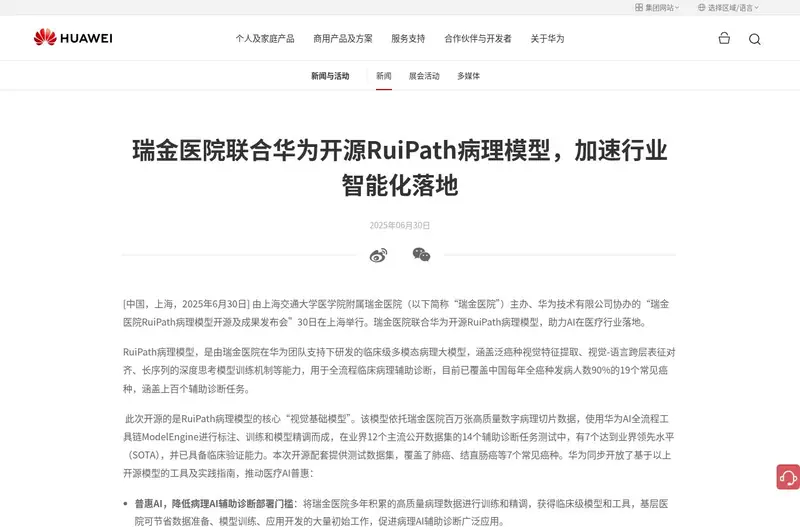
Image from the source page: Ruijin Hospital, Shanghai Jiao Tong University School of Medicine
© Huawei; rights reserved by the owner · Image source

Public case · not a BOOK.AI clientHealthcare & pharma · China

Ruijin Hospital, Shanghai Jiao Tong University School of Medicine × Huawei

FDE intensity: StrongOn-site (Huawei team stationed at the hospital)

7 of 14 diagnostic tasks reached state of the art across 12 public datasets

As reported by Huawei · 2025-06 · provider-published

Read the caseCollapse

Background

Pathology relies on scarce senior doctors with heavy slide-reading loads.

How the FDE work was done

A Huawei team was stationed at Ruijin Hospital, co-developing across data, model and application engineering with a full toolchain for labelling, training and tuning.

Results (as reported by Huawei)

SOTA on 7 of 14 tasks across 12 public datasets; clinical-validation ready; test sets cover 7 common cancers.

Takeaways

A classic on-site co-development case: engineers on location, refining data and models with experts.
Provider
Huawei
Delivery mode
On-site (Huawei team stationed at the hospital)
Region
China

Read the original ↗Original title (Chinese): 瑞金医院联合华为开源RuiPath病理模型,加速行业智能化落地 - 华为

English summary by BOOK.AI; figures as reported by Huawei. Quotation marks indicate wording from the source.
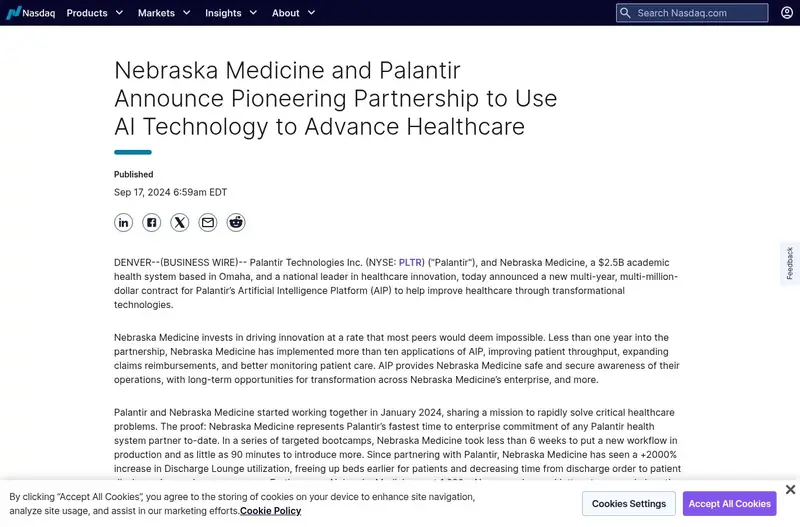

Screenshot of the source page (captured 2026-10-19): Nebraska Medicine
© Nasdaq / Palantir press release (page screenshot; content © source) · Image source

Public case · not a BOOK.AI clientHealthcare & pharma · US

Nebraska Medicine × Palantir

FDE intensity: StrongBootcamp (AIP)

“less than 6 weeks to put a new workflow in production and as little as 90 minutes to introduce more”

As reported by Palantir · 2024 · provider-published

Read the caseCollapse

Background

Slow bed turnover, long discharges, and denial appeals written by hand.

How the FDE work was done

Through targeted bootcamps, Palantir engineers and hospital staff built workflows on site — the first in under 6 weeks, later ones in as little as 90 minutes.

Results (as reported by Palantir)

+2000% Discharge Lounge utilisation; 1,200+ AI-powered appeal letters sent in under 3 months.

Takeaways

Bootcamp delivery: once the first workflow exists, the next ones ship in days or hours.

Provider
Palantir
Delivery mode
Bootcamp (AIP)
Region
US

Read the original ↗Nebraska Medicine and Palantir Announce Pioneering Partnership to Use AI Technology to Advance Healthcare | Nasdaq

English summary by BOOK.AI; figures as reported by Palantir. Quotation marks indicate wording from the source.
Public case · not a BOOK.AI clientHealthcare & pharma · China

Wuhan Central Hospital × DeepBlue Technology

FDE intensity: StrongOn-site joint R&D (20+ medical experts and engineers)

Doctors save about 2.8 hours a day on average; outpatient record quality-control pass rate up to 99%

As reported by Cnhubei (Hubei Daily) · 2025-05-15 · media report

Read the caseCollapse

Background

Doctors typed while consulting; writing medical records took up much of their time and got in the way of talking to patients.

How the FDE work was done

The hospital and DeepBlue jointly committed 20+ medical experts and engineers to co-build an AI voice medical-record system, piloted in 55 clinics across three campuses; next steps include a medical-service digital human and talent training.

Results (as reported by Cnhubei (Hubei Daily))

Doctors save about 2.8 hours a day on average; outpatient record quality-control pass rate up to 99%.

Takeaways

A mixed team of clinicians and engineers co-building on site is the archetypal FDE setup in healthcare.

Provider
DeepBlue Technology
Delivery mode
On-site joint R&D (20+ medical experts and engineers)
Region
China

Read the original ↗Original title (Chinese): 湖北首例!武汉市中心医院发布人工智能语音病例自动生成系统

English summary by BOOK.AI; figures as reported by Cnhubei (Hubei Daily). Quotation marks indicate wording from the source.

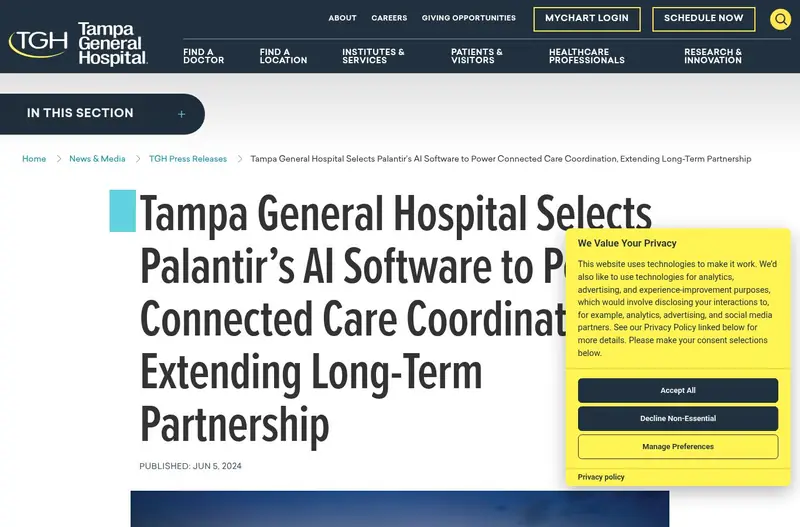
Image from the source page: Tampa General Hospital
© Tampa General Hospital; rights reserved by the owner · Image source

Public case · not a BOOK.AI clientHealthcare & pharma · US

Tampa General Hospital × Palantir

FDE intensity: MediumFDE / platform co-build

“cut by 83% the amount of time required to place patients”; PACU holds −28%

As reported by Tampa General Hospital · 2024-06 · company statement

Read the caseCollapse

Background

Tight bed and OR turnover; patient placement and PACU holds limited capacity.

How the FDE work was done

The hospital fed patient-flow data into Palantir’s AI software to support care-coordination decisions.

Results (as reported by Tampa General Hospital)

Patient placement time −83%; PACU holds −28%; mean length of stay for sepsis patients −30%.

Takeaways

Hospital operations — beds and flow — are data-rich and measurable AI targets.

Provider
Palantir
Delivery mode
FDE / platform co-build
Region
US

Read the original ↗Tampa General Hospital Selects Palantir’s AI Software to Power Connected Care Coordination, Extending Long-Term Partnership | Tampa General Hospital

English summary by BOOK.AI; figures as reported by Tampa General Hospital. Quotation marks indicate wording from the source.
Image from the source page: Novo Nordisk
© Anthropic; rights reserved by the owner · Image source

Public case · not a BOOK.AI clientHealthcare & pharma · Denmark

Novo Nordisk × Anthropic

FDE intensity: MediumIn-house team with provider support

Clinical study documentation “reduced from 10+ weeks to 10 minutes”

As reported by Anthropic · 2025 · provider-published

Read the caseCollapse

Background

Long clinical-study report writing slowed regulatory submissions.

How the FDE work was done

A small internal team built a documentation automation system on Claude; outputs go to humans for review and approval.

Results (as reported by Anthropic)

Clinical documentation from 10+ weeks to 10 minutes; CSR writing time −90%.

Takeaways

High-value documents such as regulatory files suit “AI drafts, humans approve”.

Provider
Anthropic
Delivery mode
In-house team with provider support
Region
Denmark

Read the original ↗Novo Nordisk Claude Code case study | Claude by Anthropic

English summary by BOOK.AI; figures as reported by Anthropic. Quotation marks indicate wording from the source.
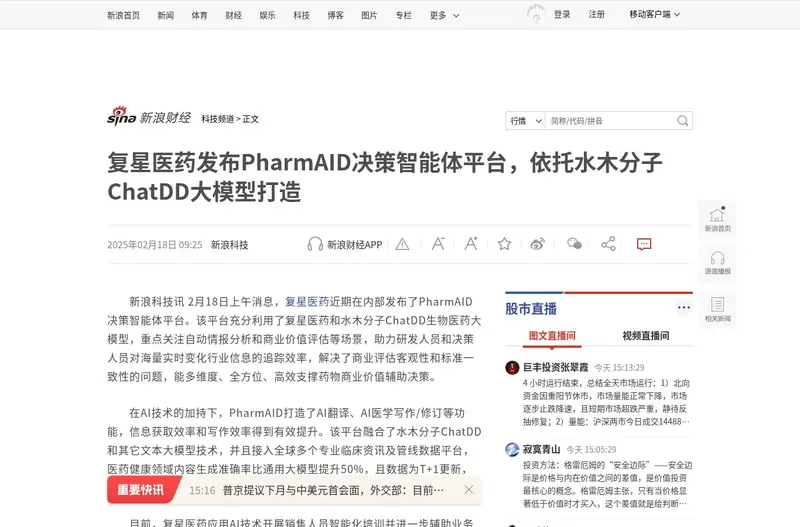
Screenshot of the source page (captured 2026-10-19): Fosun Pharma
© Sina Finance / original author (page screenshot; content © source) · Image source

Public case · not a BOOK.AI clientHealthcare & pharma · China

Fosun Pharma × BioMap / Shuimu Molecular (ChatDD)

FDE intensity: MediumCo-build

Content-generation accuracy 50% higher than general-purpose models; data updated T+1

As reported by Sina Finance · 2025-02-18 · media report

Read the caseCollapse

Background

R&D and decision teams must track fast-changing industry information; evaluation standards varied.

How the FDE work was done

Built a decision-agent platform connected to global clinical-information and pipeline databases.

Results (as reported by Sina Finance)

Content accuracy 50% higher than general models, with T+1 data updates.

Takeaways

Connecting vertical data sources is what makes domain agents useful.

Provider
BioMap / Shuimu Molecular (ChatDD)
Delivery mode
Co-build
Region
China

Read the original ↗Original title (Chinese): 复星医药发布PharmAID决策智能体平台,依托水木分子ChatDD大模型打造_新浪财经_新浪网

English summary by BOOK.AI; figures as reported by Sina Finance. Quotation marks indicate wording from the source.

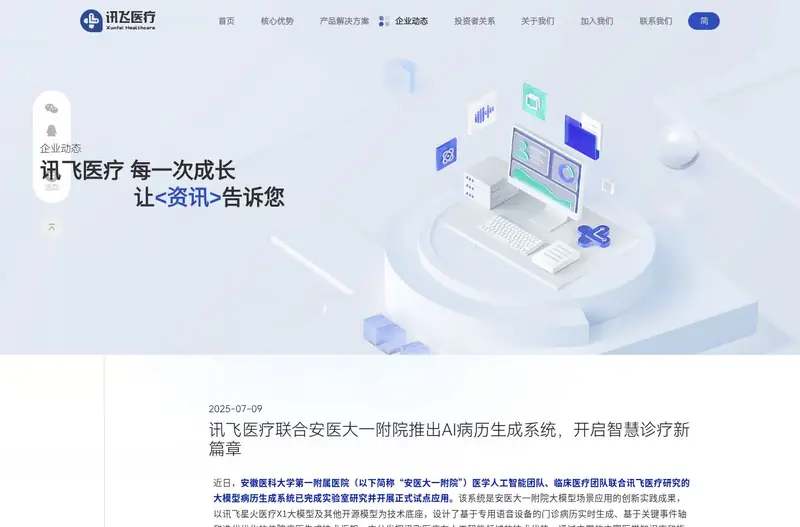
Image from the source page: The First Affiliated Hospital of Anhui Medical University
© www.xunfeihealthcare.com; rights reserved by the owner · Image source

Public case · not a BOOK.AI clientHealthcare & pharma · China

The First Affiliated Hospital of Anhui Medical University × iFLYTEK Healthcare

FDE intensity: MediumJoint R&D (clinical teams involved throughout)

Record-generation reasonableness over 83%; about 2.8 hours of record-writing saved per doctor per day

As reported by iFLYTEK Healthcare · 2025-07-09 · provider-published

Read the caseCollapse

Background

Writing records during outpatient visits, ward rounds and handovers was a heavy burden for clinicians.

How the FDE work was done

The hospital’s AI team and clinical teams worked with iFLYTEK Healthcare; GI surgery and endocrinology teams were involved throughout, reviewing reasonableness and terminology, and a formal pilot followed the lab study.

Results (as reported by iFLYTEK Healthcare)

Reasonableness of generated records over 83%, with 80%+ of generated content used, and about 2.8 hours of record-writing saved per doctor per day.

Takeaways

Having clinical departments evaluate throughout is the key step before a medical agent goes live.

Provider
iFLYTEK Healthcare
Delivery mode
Joint R&D (clinical teams involved throughout)
Region
China

Read the original ↗Original title (Chinese): 讯飞医疗联合安医大一附院推出AI病历生成系统,开启智慧诊疗新篇章-讯飞医疗-用人工智能守护生命健康

English summary by BOOK.AI; figures as reported by iFLYTEK Healthcare. Quotation marks indicate wording from the source.
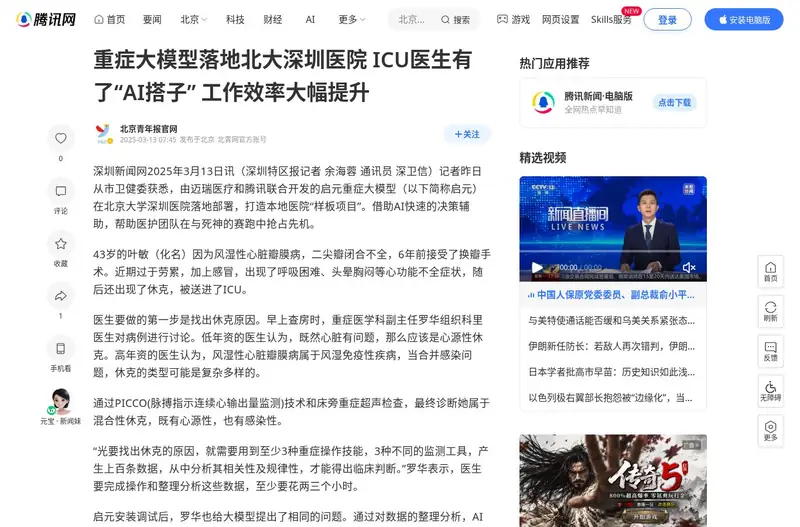
Screenshot of the source page (captured 2026-10-19): Peking University Shenzhen Hospital
© Tencent News / original author (page screenshot; content © source) · Image source

Public case · not a BOOK.AI clientHealthcare & pharma · China

Peking University Shenzhen Hospital × Mindray × Tencent

FDE intensity: MediumJoint development + on-premise deployment (multi-centre clinical collaboration)

Auto-generating a record takes 1 minute — doctor efficiency up more than 30x

As reported by Shenzhen Special Zone Daily (via Tencent News) · 2025-03-13 · media report

Read the caseCollapse

Background

ICU doctors spent two to three hours analysing hundreds of monitoring data points and compiling records.

How the FDE work was done

A medical-device maker and a cloud provider co-developed a critical-care large model, iterating on data collected, cleaned and labelled through multi-centre clinical collaboration, and deployed it locally at the hospital.

Results (as reported by Shenzhen Special Zone Daily (via Tencent News))

Auto-generating a medical record takes 1 minute, improving doctor efficiency by more than 30x.

Takeaways

Industry leader plus cloud provider: one brings scenarios and data, the other models and engineering.

Provider
Mindray × Tencent
Delivery mode
Joint development + on-premise deployment (multi-centre clinical collaboration)
Region
China

Read the original ↗Original title (Chinese): 重症大模型落地北大深圳医院 ICU医生有了“AI搭子” 工作效率大幅提升_腾讯新闻

English summary by BOOK.AI; figures as reported by Shenzhen Special Zone Daily (via Tencent News). Quotation marks indicate wording from the source.
See public FDE practice across all 14 industries →

An AI roadmap you can act on — in 14 days

Free diagnostic: on-site interviews, role-by-role AI scoring and a cost model. Run the numbers first, then decide.